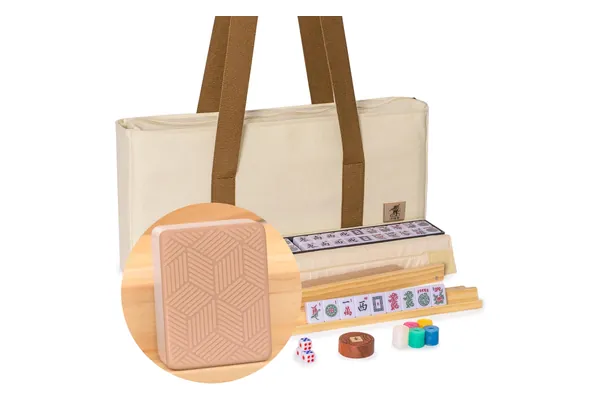
Best first set
Yellow Mountain Imports American Mahjong set
Tiles, 4 racks with pushers, dice and a case in one box
Check priceBeginner tutorial · NMJL rules
American Mahjong is a four-player tile game: you pass tiles in the Charleston, then draw and discard until your 14 tiles match a hand on this year’s National Mah Jongg League card.
Learn it in about 10 minutes, with pictures and animations you can step through.
Rules summarized in our own words. Checked against the 2026 card, Oct 2026.
Some links earn us a commission. How that works
An American set (sold as 166 tiles, with spare jokers and blanks; you play with 152), four racks, and this year’s card from the National Mah Jongg League. A Chinese 144-tile set won’t work: it has no jokers.
Best first set
Tiles, 4 racks with pushers, dice and a case in one box
Check price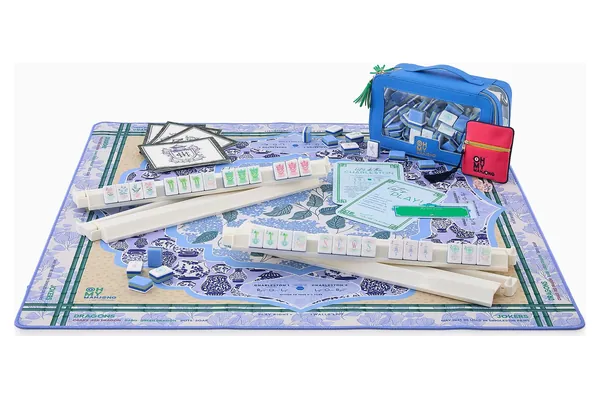
Designer pick
The colorful designer set, with racks and a mat
Check price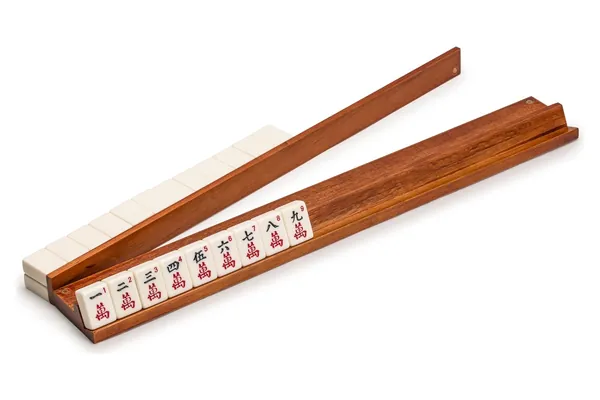
Old set? Add these
Natural wood racks with pusher arms, for an older set without them
Check priceRequired
You need the current card to play, and it changes every April. One card for each player at the table.
Check priceAn American Mahjong set has 152 tiles in seven kinds. Dots, Bams and Craks are the three suits: families of tiles numbered 1 to 9, like hearts and spades in a deck of cards. Winds, dragons, flowers and jokers aren’t suits.
A suit of circles, numbered 1 to 9. There are four of each number.
Partner dragon: the White Dragon, called Soap.
A suit of bamboo sticks, numbered 1 to 9, four of each. In many sets the 1 Bam is drawn as a bird.
Partner dragon: the Green Dragon.
A suit of characters (also spelled Cracks), numbered 1 to 9, four of each. Each one carries the Chinese character for ten thousand.
Partner dragon: the Red Dragon.
North, East, West and South. Four of each.
On the card, winds are written as N, E, W and S.
Red, Green and White, four of each. Each dragon belongs with one suit.
The White Dragon (Soap) also stands for zero, like the 0 in 2026, and can go with any suit.
Eight flower tiles. In American Mahjong, any flower counts the same as any other.
On the card, flowers are written as F.
Eight jokers. A joker can stand in for any tile in a group of three or more.
Never in a pair or a single. More in step 6.
Shuffle the tiles face down. Each player builds a wall 19 tiles long and 2 high, right up against the pusher on their rack.
East is the dealer and plays first. Roll the dice to choose who starts as East.
Like cutting a deck of cards. East rolls the dice, counts that many stacks in from the right end of their wall, and splits the wall there. Those counted stacks stay against the rack. East uses the rack’s hinged pusher to swing the long part of the wall out at an angle toward the middle, where everyone can reach it. The deal starts at the gap.
Always in order, never from anywhere you like. Starting at the gap and moving left along the wall, each player in turn takes the next 2 stacks (4 tiles), three times around. Then East takes 2 more and everyone else 1, so East has 14 tiles and everyone else has 13. When East’s wall runs out, the player on East’s left pushes their wall out and the deal carries on from it. Draws during the game continue from the same spot.
Before the first turn, everyone passes unwanted tiles around the table. It’s the part of American Mahjong that confuses new players most, so step through it here.
Jokers can never be passed.
Getting ready
Everyone chooses 3 tiles they don’t want and sets them face down. You can never pass a joker.
First Charleston
Give 3 tiles to the player on your right, and take the 3 coming from your left.
First Charleston
Choose 3 more and swap them with the player across the table.
First Charleston
Pass 3 to your left. On this last pass you may pass on 1, 2 or 3 tiles you just received without looking at them (a blind pass).
Second Charleston (optional)
Go around again in reverse. Any player can stop the Charleston after the first left pass, so this round only happens if everyone agrees.
Second Charleston (optional)
Swap 3 tiles with the player across.
Second Charleston (optional)
The last pass of the second Charleston. A blind pass is allowed here too.
Courtesy pass (optional)
You and the player across may trade 0, 1, 2 or 3 tiles. It’s optional, even if you skipped the second Charleston.
Ready to play
The Charleston is over. East starts the game by discarding a tile, and play moves to the right.
Step 1 of 9
To win, your 14 tiles must match one hand on this year’s card exactly. The League prints a new card every April, so the winning hands change each year.
11122223334444
Two suits: the green groups in one suit, the red groups in another. For example, 111 and 333 in Bams, 2222 and 4444 in Dots.
FFDDDDNEWSDDDD
Flowers, two kinds of dragons, and one of each wind.
1133557799FFDD
All pairs, so it must stay concealed, and jokers can’t help.
East already holds 14 tiles, so on the very first turn East only discards. After that, everyone, East included, draws one tile and then discards one, so you always end your turn with 13. Play moves to the right (counterclockwise).
Take the next tile from the wall.
Put one tile face up in the middle and say its name out loud.
Say “call” to take the last discard if it finishes a group of three or more, or wins you the game. You can’t call for a pair or a single unless it wins. Show the group on your rack, then discard.
When you call someone’s discard, you have to prove what it’s for. Take the tile, add the matching tiles from your hand, and set the whole group face up on top of your rack. That group is an exposure.
The called discard (dashed) plus two tiles from your hand: an exposed pung.
The rest of your hand: hidden, facing you
A joker can stand in for any tile in a pung, kong, quint or sextet, but never in a pair or a single. A discarded joker is dead: nobody can pick it up.
A pung (3 of a kind)
A kong (4 of a kind)
A pair
A single tile
On your turn, if another player has exposed a joker and you hold the tile it stands for, you can trade your tile for the joker.
Their exposure, and the 8 Dot from your hand.
“Mah Jongg!”
You hold 13 tiles, so the 14th tile that completes your hand comes one of two ways:
Then lay your whole hand face up so everyone can check it against the card.
Who pays the winner (in points, chips or small change)
If the wall runs out before anyone wins, it’s a wall game: no one pays, and you deal again.
No. Jokers can never be passed, in any part of the Charleston or the courtesy pass.
Only if that tile gives you Mah Jongg. Otherwise you can call a discard only to finish a pung, kong, quint or sextet that you then expose.
No. You can trade a matching tile for a joker in any player’s exposure, but only on your own turn.
Any player. The Charleston can be stopped after the first left pass, so the second Charleston only happens if everyone agrees to it.
A player calling Mah Jongg always gets it. If both players want it for an exposure, the player next in turn after the discarder gets it.
No. A discarded joker is dead and nobody can call it. The player who throws it can name it as “joker,” “same,” or the name of the previous discard.
If you haven’t shown your hand and everyone else’s hand is intact, play continues with no penalty. If you exposed all or part of your hand, your hand is dead: you stop playing but still pay the winner.
Yes. When you win without any jokers, everyone pays double. Singles and Pairs hands are the exception, since they never use jokers anyway.
Ready for your first game?
Keep this page open at the table. Every section works on a phone.
RuleRef explains rules in its own words. The hands on the official card belong to the National Mah Jongg League; buy the current card from the League.